



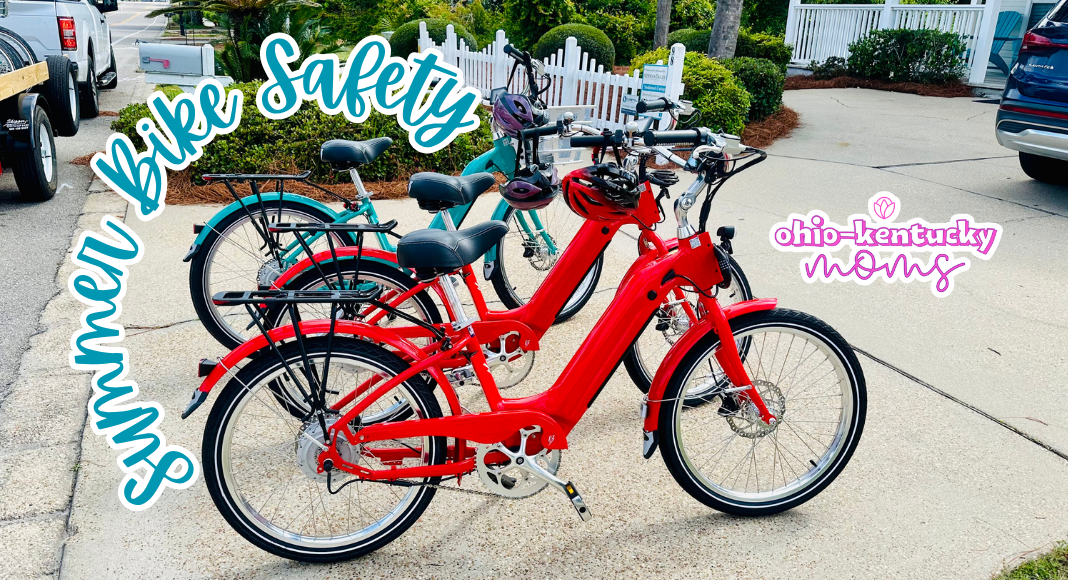
We not only want to keep our kids safe while biking, we also want to make sure none of us are unwittingly breaking the law. Ignorance is not a valid defense, so we’re here to help you understand some of the basics for summer bike safety in Kentuckiana.
As the warmer months have gotten into full swing, I’ve seen a lot of kids out on their bikes. Bike riding was one of my favorite pastimes all growing up, and we’ve done tons of biking with our daughter since she was a toddler and have even gotten into e-bikes over the last few years. One thing I remember from our family bike rides in my youth was my parents instilling all the laws and safety precautions.
Spending a lot of our time in both Indianapolis and upstate New York growing up, I used to hate that we didn’t have to wear helmets in Indiana but did have to in New York. A lot of travel happens in summer between states and even within neighborhoods around town. This got me thinking about how the laws are not only different from state to state but also from county to county and even within different cities. With the emergence of e-bikes, the laws have evolved even more.
Roadway & Sidewalk Riding Rules
The entire Tri-State (Ohio, Indiana, and Kentucky) considers bicycles “vehicles”, and cyclists are required to follow all traffic laws as such. Stop at stop signs and red lights, yield to walking pedestrians, and ride with traffic as far right as you can if riding on roadways. This is a great opportunity to teach your kids the basics of traffic laws well before they reach the driving age.
Use bike hand signals when turning or stopping. Kentucky does require bike hand signals to be used according to state and local interpretations on the law. Indiana Code 9‑21‑11‑2 requires cyclists to use hand signals when making turns or indicating lane changes. On BikeTips, they shared the “10 essential bike hand signals: left turn (extend left arm out), right turn (extend right arm out OR bent left arm pointing up), stop (left arm bent down at 90°), slowing (left arm extended downward, palm back), pothole/hazard (point at the obstacle), gravel (open hand wave near the ground), debris on the right (right hand pointing down), thanks (small wave), letting traffic pass (waving traffic forward), and group ride single-file (one-finger raised).”
A general rule of thumb if you need to be on a roadway without a motor vehicle is to “ride with and walk against” traffic. I see far too many people lately walking with traffic and not against, and it causes so many more opportunities for accidents to happen to the pedestrian. When walking against traffic, you have a chance to see any cars headed your way, and they have a better chance of seeing you in advance. Another good rule for bike safety is to get off your bikes and walk them across intersections and crosswalks. I have only seen one person do this all spring and summer so far, and it is a very effective way to give you more control over an accident if a car were to not yield as they should (which we all know happens way more often than we’d like to think).
Kentucky state law allows for sidewalk riding in general. However, when riding on a sidewalk or crosswalk, cyclists have the rights and duties of a pedestrian. Key requirements include slowing down to walking speed when pedestrians are present or expected, or when approaching driveways, crosswalks, or intersections; obeying pedestrian traffic signals and using verbal signals or bells to alert pedestrians of your presence; and avoiding sudden movements that could create a hazard. Cities like Louisville or Lexington usually prohibit sidewalk riding in certain high-traffic areas or business districts. Be aware that some cities do have fines anywhere from $25 – $100 where sidewalk riding is prohibited.
Indiana does not have a statewide law that authorizes or prohibits sidewalk cycling. The rules are left to the local municipalities. As an example, Indianapolis prohibits sidewalk riding in the Mile Square downtown core. Restrictions are most common in central business districts, downtown cores, and school zones. Even where sidewalk riding is allowed, remember that all other Indiana traffic laws still apply to cyclists.
When riding on sidewalks where pedestrians are present, make sure you and your children call out “On your left!” or “On your right!” to let others know you’re approaching and to avoid accidents. The tri-state also has varying laws for reflectors or lights being used at dusk and at night. As always, check the local rules for where you plan to bike with your family.
Helmet Laws
Kentucky currently has no statewide bicycle helmet laws, but some cities have their own regulations, particularly for children under 12. For example, in Louisville, children under the age of 12 are required to wear helmets while riding anywhere in the city, and anyone under 18 must wear a helmet in metro parks. Make sure to check local laws where you plan to cycle.
In Indiana, as when I was younger, there is no statewide bicycle-helmet law. A handful of municipalities encourage helmet use through public-safety campaigns but do not mandate it.
A general safety practice is to just have your kids wear a helmet at all times, along with knee and elbow pads.
LMC Pro Tip for Parents :: Teach your kids to follow all traffic laws, wear helmets where required, and check local rules before riding. Even without a helmet law, safety gear and awareness reduce injury risk.

E-Bike Rules for Kids
Some states regulate e-bikes by class. Class 1 e-bikes provide pedal-assist up to 20 mph, Class 2 e-bikes have a throttle up to 20 mph, and Class 3 e-bikes offer pedal-assist up to 28 mph.
Kentucky has no statewide Class 1/2/3 e-bike statute; the closest framework covers electric low-speed scooters, which riders 16 and older may use on highways, bike lanes, and bike paths. Local ordinances still apply and property managers get to make their own rules, so confirm locally before you ride. There is no statewide helmet law just as with regular biking. In the state, follow all safety and legal guidelines for e-bikes as you would standard pedal bicycles.
Indiana is generally an e-bike friendly state. To be more inclusive, the Indiana Department of Natural Resources (DNR) allows some e-bikes on some trails. E-bikes are not permitted on trails where bikes are not permitted. There are some rules around speed, classes, sidewalks, trails, and local city restrictions that can catch riders off guard. Helmets are not required but are recommended. There is no statewide minimum age, but localities typically require Class 3 riders to be 16 or older.