



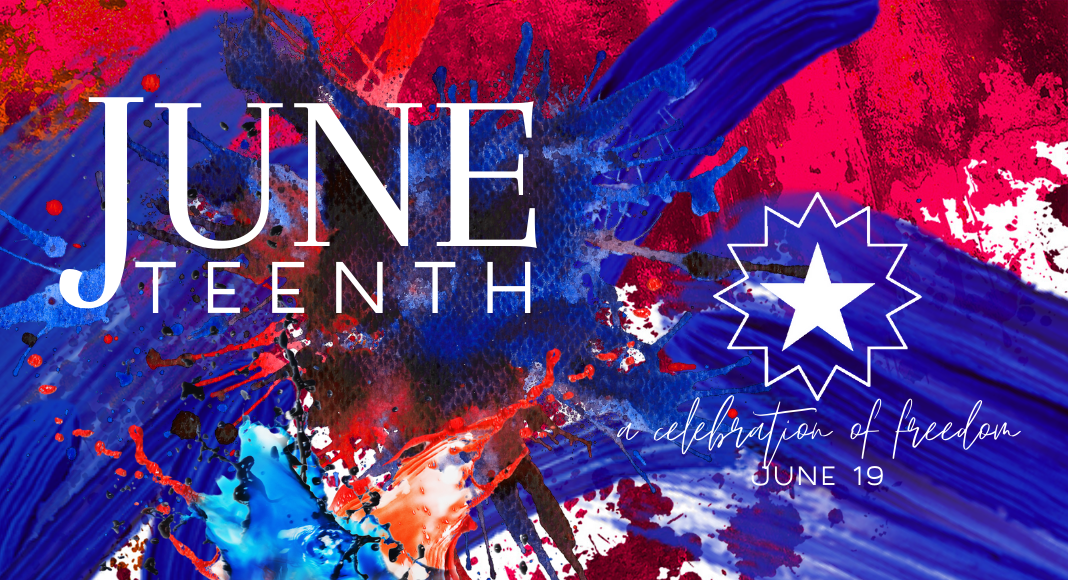
Did you know that there’s more than one Independence Day in America?? There’s the day our country claimed its independence from Great Britain and then there’s the day that all slaves finally knew they were free in this country as well, almost 100 years later. This day of celebration of freedom is known as Juneteenth and is observed every year on June 19th.
On that day in 1865, a General by the name of Gordon Granger rode into Galveston, Texas to announce the freedom of enslaved people. Abraham Lincoln’s Emancipation Proclamation had been about 2 ½ years earlier on January 1, 1863. The quarter-of-a-million people in slavery in Texas had been free for quite a while – they just didn’t know it yet. And, the slave owners in the South had been in no big hurry to inform them either. Even with how slowly news traveled back then, a 30-month period of time to get a message across the country to Texas seems a bit excessive to say the least.

General Order No. 3 reads, “The people of Texas are informed that, in accordance with a proclamation from the Executive of the United States, all slaves are free. This involves an absolute equality of personal rights and rights of property between former masters and slaves, and the connection heretofore existing between them becomes that between employer and hired labor. The freedmen are advised to remain quietly at their present homes and work for wages. They are informed that they will not be allowed to collect at military posts and that they will not be supported in idleness either there or elsewhere.”
The previously enslaved people were essentially urged to stay and work for their former masters. Even if they were getting paid now for their labor, who would want to stay in that environment? Most didn’t stay. Rather, they left Texas in “the scatter” and found family members in the more welcome North. Although the announcement of freedom had made its way to Texas in 1865, old reports show that the last slaves weren’t freed in the State until 1868, another three years later.

The sad truth of history is that many former slave owners beat, lynched, and murdered many of the freedpeople that tried to leave. The struggle of Black Americans did not end in 1863 or 1865… or 1868. Even trying to celebrate the anniversary of their newfound “freedom” in 1866 was met with resistance. Segregation laws were quickly expanding, and there were no public places for Black people to gather. Former slaves got together in the 1870s to buy ten acres of land and called it “Emancipation Park”, which was really the only park open to African Americans in Texas until the 1950s.
It wasn’t until 1980 that a State formally recognized Juneteenth as a holiday, and Texas was the first one to do so.

A woman named L. J. Graf designed the Juneteenth flag, and she packed it full of symbolism. The red, white, and blue colors reflect that enslaved people were Americans and so are their descendants. She paid Texas a tribute for being the first State to recognize the holiday by placing the middle star on the flag design. The bursting star around the center star stands for the newfound freedoms of the freedpeople.
Juneteenth celebrations did not gain steam until a century after Black slaves were declared free people. It was certainly not for a lack of wanting to celebrate their freedom, but how can it feel like a celebration when there is oppression at almost every turn for people of color in this country?

In the midst of revived celebrations these past several decades, Black Americans still are subject to systemic racism in this country. It’s going to take ALL of us as parents to raise children that are anti-racist and to effect real change in this country, not just Black parents or parents of children of color whom it impacts most.
We should all be doing more for our brothers and sisters of color in the U.S. If we have learned nothing the past couple years, we have learned that we must not and cannot remain silent any longer. Join us in helping Black Americans truly get a chance to celebrate freedom in this country. Let’s all keep learning more and doing more.